Fast Shipping. Reliable Service. Every Time.

Get your machines and supplies delivered quickly because deadlines shouldn’t wait.

Frequently Asked Questions

Measure the complete contents, including sheet protectors, dividers, pockets, tabs, and inserts, rather than selecting capacity from paper count alone. Ring capacity is based on the ring size, but the actual number of sheets varies with paper weight and added materials. Leave enough room for pages to turn without crowding the rings. The wider range of ring binders can help when the project may also suit a non-view, presentation, or specialty format. A binder that is filled to its limit can place stress on the mechanism, covers, and punched holes, so some unused capacity is helpful.

Round rings are a practical choice for everyday filing and documents that will be opened and updated regularly. D-rings place the straight side of the mechanism against the back cover, which can help pages sit more evenly and may support greater capacity within a similar binder size. The best option depends on document thickness, handling frequency, and whether the binder must lie neatly on a shelf. Regardless of ring shape, confirm that the mechanism opens and closes evenly. Misaligned rings can catch or tear pages. Consider how often sheets will be added and whether protected documents or dividers will increase the finished thickness.

Measure the actual clear pockets rather than using the binder’s outside dimensions. Cover inserts should slide in without buckling, while spine inserts need enough clearance to enter the narrow pocket cleanly. The selection of binder accessories may provide labels, pockets, dividers, and other organizational items for the finished binder. Use paper that is firm enough to insert but not so thick that it stretches the overlay. Print and trim one sample first, then confirm that titles remain visible when the binder is standing, lying flat, and viewed from the front.

A non-view binder may be better when exterior customization is unnecessary, the binder will receive rough handling, or printed inserts could become damaged or outdated. View binders are useful for manuals, proposals, training materials, and records that need visible titles or branded covers. Consider whether the binder will be reused for different projects. Clear pockets make updates easier, but they may not be needed for long-term files identified only by a spine label. The cover material, hinge construction, ring quality, and expected handling should carry more weight than appearance alone when the binder will be used frequently.

Use sheet protectors when documents need protection from handling, spills, tearing, or repeated removal. They work well for reference sheets, photographs, instructions, menus, and materials that should remain unpunched. Protectors increase the total thickness considerably, so choose binder capacity after assembling a representative section. Finish also matters because glossy sleeves may create reflections under strong lighting, while non-glare options can be easier to read. Make sure the sleeve punching aligns with the rings and that dividers extend far enough to remain visible beyond the protector edges.

How are Ring Binders Measured?

How are Ring Binders Measured?

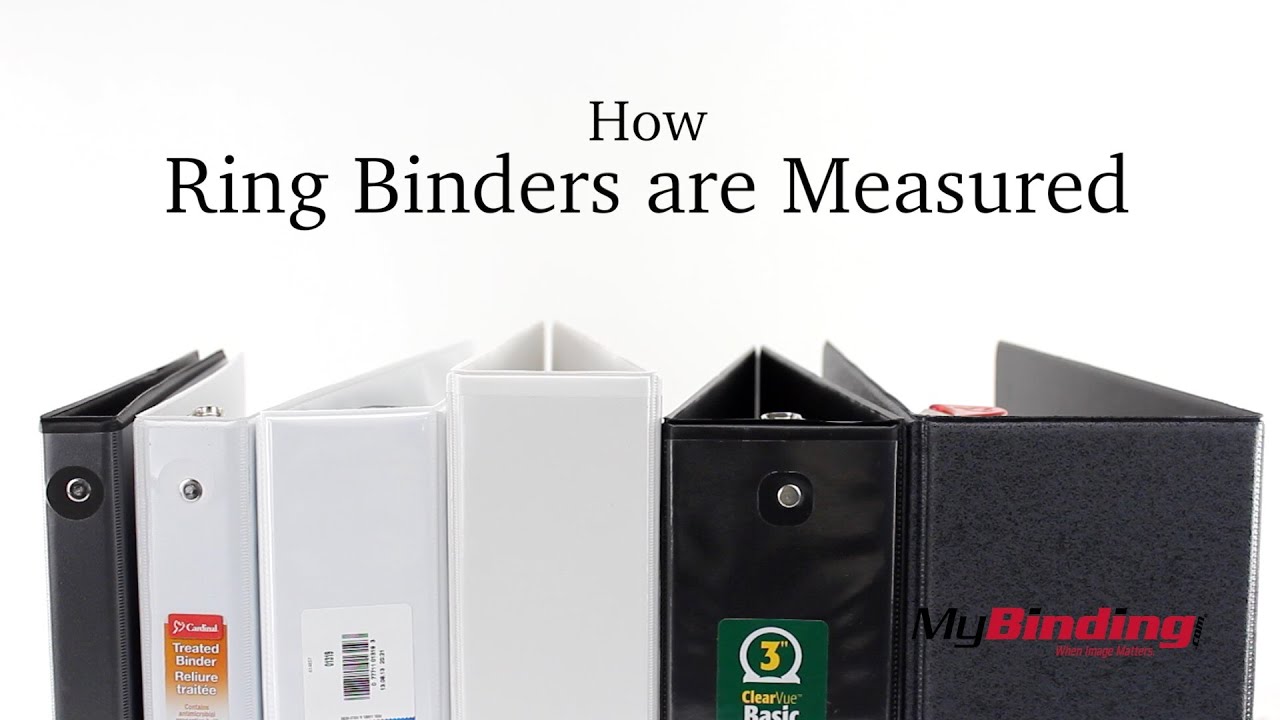
Mybinding.com presents How Ring Binders are Measured. These binders are all labeled different sizes from 5/8 of an inch to 5 inches. But what does measurement actually mean? Well, they are not all the same but they are referring to the ring sizes. For round rings, the measurement is the diameter of the inside of the rings. For slant or D rings, it is the length of the straight edge. Then 5 inch binders come in and ruin everything they’re measured from cover to cover and not by the ring sizes. Imagine it being more like how big of a stack of pages you can fit in your binder and not a measurement of the thickness of the binder itself. If you are curious, here are some approximate cover widths for the corresponding ring sizes. You can see that a 5/8 inch ring binder is actually slightly over an inch thick, and a two-inch binder can be almost 3 inches thick.

Featured Blogs

View all
Binding101 2018 Best Sellers

Binding101 2018 Best Sellers

Here is a list of our top-selling equipment for 2018, across all product categories, by volume of...

Read More
DIY Booklets: How to Make Event Programs, Catalogs, & Magazines

DIY Booklets: How to Make Event Programs, Catalogs, & Magazines

From handmade zines to polished product catalogs, folded and bound booklets are a classic way to share...

Read More
How to Make Custom Calendars: A Step-by-Step Guide

How to Make Custom Calendars: A Step-by-Step Guide

Custom calendars aren’t just great for organization — they’re also an excellent product line for small businesses,...

Read More